The cave art of the Mediterranean (1998)

Unesco


These sites in the Mediterranean Arc of the Iberian Peninsula (Spain), and their cave art, which dates from the end of the pre-historic period, constitute an exceptional set of works and provide a fascinating insight into how people lived during what was a critical phase of human development. The lively, graphic representations are unique not only on account of their style, buy also because of the themes that they portray. The set of cave paintings from the end of the pre-historic period located in the Spain’s eastern Mediterranean arc forms the largest group of cave art locations in the whole of Europe, and offers an exceptional perspective of the live of man in an essential period of human cultural evolution.

In total 16 of Lleida’s archaeological sites have been recognised by UNESCO as depositories of cave paintings of great value. They are important because they represent both one of the first artistic manifestations of the primitive Mediterranean civilisation and because they constitute an embryonic form of later plastic art forms.
This distinction has been granted to remains found in Western Catalonia (Spain) that include La Roca dels Moros del Cogul, one of the best conserved pieces of cave art, which provides an excellent example of the art that developed in this territory during the Palaeolithic period. It also includes the Cova de Cogulló, at Vilanova de Meià; the Cova dels Vilasos, at Os de Balaguer, and the cave art of the Vall de la Coma and the Balma dels Punts, both at L'Albi. Elements with very unique characteristics can also be seen at the Roc del Rumbau at Peramola or in the Abrics of La Granja d'Escarp, which were found as a result of mining prospecting. Other sites include the Abric de la Vall d'Ingla, at Bellver de Cerdanya; the Roques Guàrdies, at Les Borges Blanques; the Aparets, at Alòs de Balaguer; the Cova d'Antona, at Artesa de Segre; the Balma del Pantà and Cova del Tabac, at Camarasa; the Balma de les Ovelles, at Tremp, and the cave paintings of Alfés. All of these sites are top level, cultural heritage sites on a world scale that can be found in the comarques (local districts) of Lleida (Spain).


Information provided by:

Departament de Cultura de la Generalitat de Catalunya


The Moors' cave of Cogul

Contact information:


The Moors' cave of Cogul

Oficina d''Informació i Difusió Museu d''Arqueologia de Catalunya - Passeig de Santa Madrona, 39
08038, Barcelona
Web: www.mac.cat
Email: difusiomac.cultura@gencat.cat
934246577 - 934232149


Share:


Comparteix a facebook
Comparteix a Twitter
Compartir a Whatsapp
Envia a un amic
Imprimir


  • Unesco

    La Roca dels Moros (The Moors' Rock) of El Cogul (Les Garrigues - Spain) is a key site for studying cave paintings. This is one of the most important and well-known sites on the Iberian peninsula and has been declared a UNESCO World Heritage Site.
     
    The cave is a cavity which is approximately 10 metres wide, 3 metres deep and 4 metres high. It must have offered a series of rather special conditions because it seems to have been used by man for around 5000 years, until around 100 BC. Visible evidence of this use is provided in the form of the cave paintings and engravings found in the central part of the cavity.
     
    Archaeological excavations carried out at the site have also confirmed that it was exclusively used as a place of worship, jthe type of remains found at the site suggests that it was not the permanent place of residence of any of the groups who used it. It should be added that La Roca dels Moros lies within an area that is known to have been almost continually inhabited by man since Palaeolithic times and is therefore very rich in archaeological remains.
     
    The people who live near the site already knew about it and knew that they were quite old, but attributed them to the time of the Moorish occupation. This explains why the place came to be called La Roca dels Moros. It was not, however, until the early 20th century that the paintings became widely known to researchers, who came from all over Europe to study them. The remains at La Roca dels Moros of El Cogul then soon came to be known to academics as one of the most important groups of parietal art in the Iberian Peninsula. But that was not all: this site soon stimulated a more general interest among scholars in looking for and investigating other examples of cave painting in Spain.
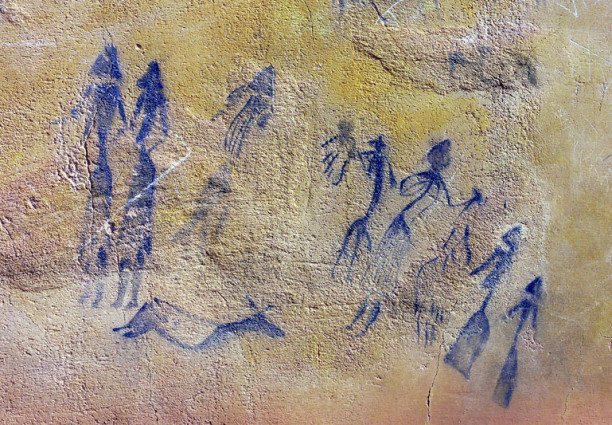
    The group of pictures consists of 42 painted figures and 260 elements engraved in the rock. Of particular note is a scene depicting several female figures surrounding a male, who can be identified by his sexual organ.
     
    The first groups to use La Roca dels Moros were the last of the hunters and gatherers (8000 to 5000 BC), who left behind paintings that belong to what is known a art llevantí (Levantine art). This places the cave and its art within a category that is only found in the Mediterranean basin of the Iberian Peninsula and the south of France and whose main iconographic elements are representations of humans and animals.Later, between 5000 and 2000 BC, Neolithic groups drew images related with their beliefs, but with representations that were very different stylistically and that can be included in the art esquemàtic (schematic art) group. Amongst these prehistoric paintings, there are also other much later inscriptions dating from the Iberic and Roman periods, though many of these are illegible.
     
    Archaeological excavations undertaken at La Roca dels Moros have made it possible to confirm the chronology of the paintings. Various instruments were found dating from the end of the Palaeolithic and the Neolithic periods as well as some handmade pottery. Pottery has also been found that dates from the Roman period.